

When crypto works, the promise is that you have full control of your own money. But when something goes wrong and your crypto is stolen, there is no bank to call, no button to reverse the charge, and no “undo” option on the blockchain.
If you are reading this because your crypto was stolen just now, here is what you need to know: what you do in the first few hours changes everything. Most people panic, rush, and make the situation worse. This guide explains exactly what to do if your crypto is stolen — step by step — what works, what doesn’t, and how to avoid being targeted a second time.
Why Crypto Theft Feels So Brutal
Cybercriminals can move stolen cryptocurrency across different blockchains within minutes. Wallet addresses do not automatically identify individuals. As a result, crypto theft is especially difficult to reverse. By the time you notice the theft, the coins may have already travelled several hops away from your original wallet.
That may sound disheartening — but here is the important part: every transaction leaves a permanent track on the blockchain. The thief cannot erase that history. That transparency is your most powerful weapon when it comes to recovering stolen cryptocurrency.
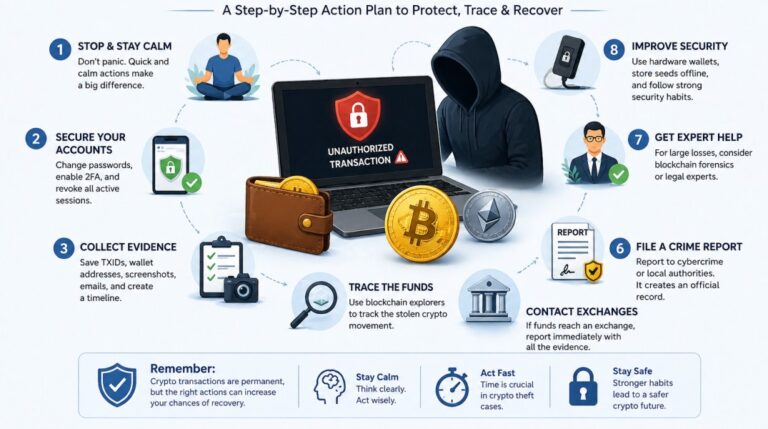
Step 1: Stop — Do Not Touch Anything Just Yet
The first thing most victims do is start clicking everywhere. They open their wallets, log into their exchanges, and frantically click around. This often exposes more information to the attacker. Take a pause.
Think of it as a digital crime scene. You want to preserve evidence and prevent any further access. Disconnect the device you used from the internet. Do not revisit the same site or app. Do not attempt any recovery steps on a compromised device until you know exactly how the attack happened. Clear thinking beats fast thinking every time.
Step 2: Immediately Secure Your Crypto Wallet and All Other Accounts
If your crypto wallet was hacked or drained, the attacker likely got in through one of these routes: a phishing attack on your crypto wallet, malware installed on your device, a compromised email account, or a leaked seed phrase.
Your other accounts may be at risk too. Here is what to do on a clean, separate device:
- Change your email password immediately and enable authenticator-based two-factor authentication (2FA)
- Change passwords on all exchanges and wallets
- Revoke all active sessions and API keys connected to your accounts
- If funds remain in any wallet, generate a brand new wallet on a secure device and transfer them out — do not reuse old seed phrases under any circumstances
Step 3: Collect Evidence Like an Investigator
This step is critical and is most often skipped. Open a notepad and start building a complete timeline:
- Your wallet address
- The thief’s wallet address
- Transaction IDs (TXIDs)
- Exact date and time of the theft
- Screenshots of your wallet transaction history
- Any emails, messages, or links you interacted with before the theft
- The website or app you were using at the time
This evidence becomes essential when you contact exchanges, law enforcement, or blockchain forensics experts. Small details matter far more than most people expect.
Step 4: Track the Stolen Crypto Using a Blockchain Explorer
This is where blockchain transparency works in your favour. Paste the TXID into a blockchain explorer such as Etherscan (for Ethereum) or Blockchain.com (for Bitcoin) and follow where the funds went.
You may see the stolen crypto being moved through multiple wallets as the attacker uses “peel chains” or mixers to obscure the trail. Keep tracking every hop. The goal is to see whether the funds eventually land at a centralised exchange — because that is where your stolen bitcoin recovery case has the best chance of moving forward. Centralised exchanges follow KYC rules, meaning they can identify who deposited the funds.
Step 5: Contact Exchanges and Platforms as Fast as Possible
As soon as you see the stolen funds arriving at an exchange, report it to that exchange’s fraud team immediately. Provide:
- Your wallet address and the thief’s wallet address
- Transaction IDs and a full timeline
- Screenshots of all evidence
Exchanges can freeze coins before the attacker cashes them out — but only if you act fast. If the original attack happened on a specific platform, contact them too as they may hold internal logs that support your case.
Step 6: How to Report Stolen Crypto to Authorities
Many victims believe this step is pointless. It is not. Filing an official report to report stolen crypto creates a legal paper trail that exchanges often require before acting on freeze requests. It also feeds into national databases that help law enforcement identify patterns across thousands of cases — which is how the largest recoveries happen.
Depending on your country, report to:
- USA: FBI Internet Crime Complaint Center (IC3) at ic3.gov, and the FTC at reportfraud.ftc.gov
- UK: Action Fraud at actionfraud.police.uk
- Other countries: Your national cybercrime unit or financial crimes regulator
Ask for a case number and keep a copy of your report.
Step 7: Consult Blockchain Forensics or Legal Experts
For significant losses, professional blockchain forensics investigators can trace stolen funds across wallets, blockchains, and bridges — far beyond what a basic explorer shows. Crypto lawyers can issue legal requests to exchanges and coordinate directly with law enforcement.
Important warning: Many fake “crypto recovery services” specifically target victims after a theft. If anyone guarantees they can recover stolen cryptocurrency for an upfront fee, they are running a scam. Legitimate professionals discuss the investigation process honestly — they never promise magic outcomes or demand payment before starting.
Step 8: Understanding What Crypto Scam Recovery Really Means
Set realistic expectations. Blockchain transactions cannot be reversed. However, if the thief makes an error — such as sending stolen funds through a regulated exchange — then speed, documentation, and tracing can create a real recovery window. In some cases funds are returned to victims; in others, seizure operations disrupt the criminal network and prevent further harm.
Crypto scam recovery is possible, but it depends on timing, evidence quality, and whether the funds pass through a point where intervention is legally possible.
Common Theft Scenarios and What They Mean for Recovery
- Seed phrase stolen or leaked: A full wallet compromise. Very little can be done unless the funds pass through a regulated exchange.
- Phishing attack on your crypto wallet: Usually involves malware or credential theft. Document everything and follow the steps above.
- Exchange account hacked: Exchanges often log all activity and may carry insurance. Contact their fraud team immediately and file a police report.
- Social engineering or investment scam: These are confidence crimes. Documentation, reporting, and professional crypto scam recovery services are your best options.
Your Immediate Action Checklist
If your crypto was stolen, follow this order right now:
- Stop using the compromised device
- Secure your email, exchange accounts, and remaining wallets on a clean device
- Document wallet addresses, TXIDs, timestamps, and a full timeline
- Trace stolen funds using a blockchain explorer
- Contact exchanges where the funds appear and request a freeze
- File a report with cybercrime authorities and get a case number
- Consider professional blockchain forensics or legal help for large losses
- Upgrade your security practices before touching crypto again
If your crypto was stolen, follow this order right now:
Once the immediate crisis settles, upgrade your security for good. Use hardware wallets for long-term storage and keep seed phrases written offline — never stored digitally. Never enter your seed phrase into any website under any circumstances. Use an authenticator app for 2FA on every exchange. Regularly revoke wallet permissions for unknown dApps. In crypto, security is not optional — it is part of ownership.